
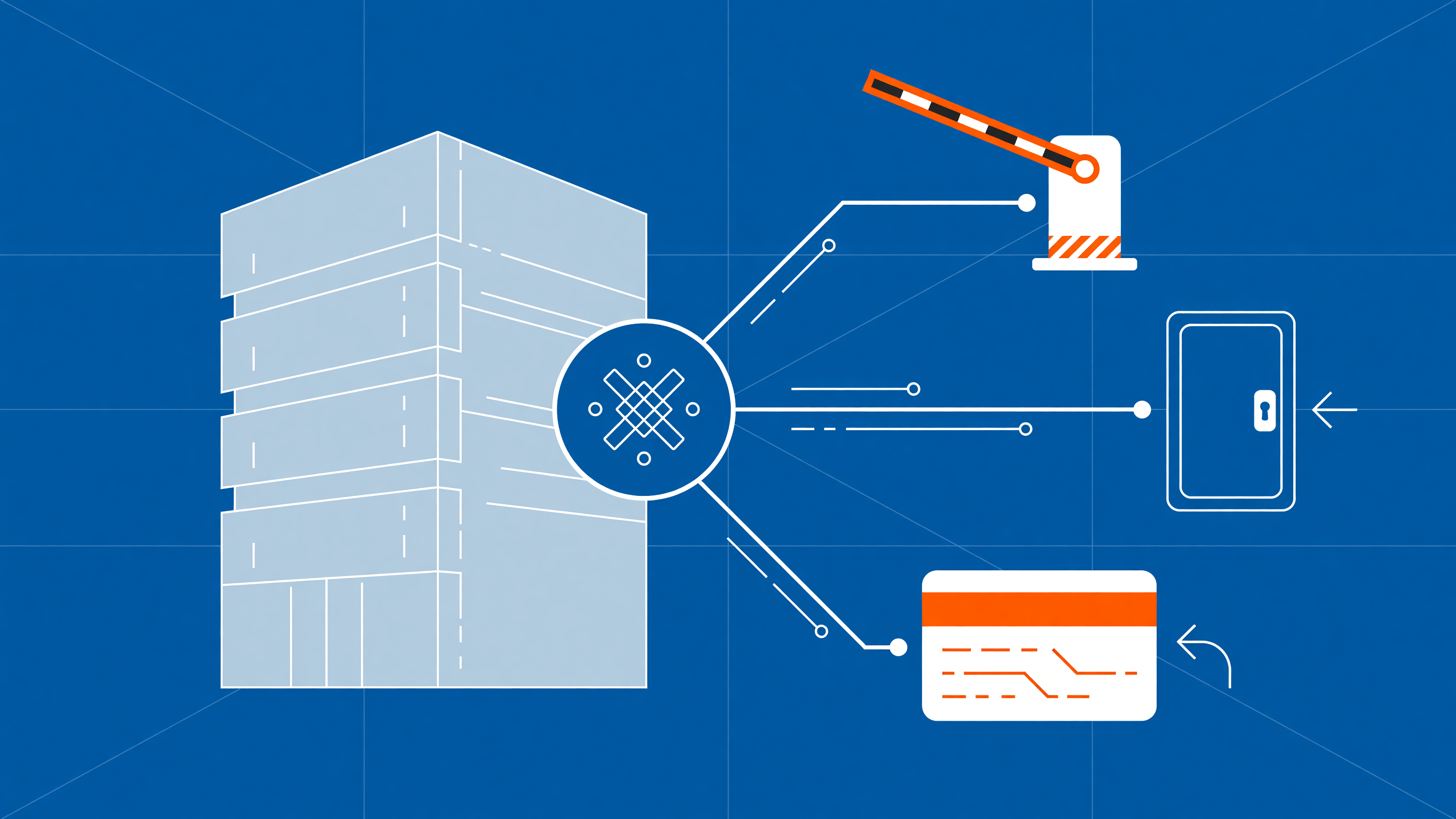
Parking used to be an island — its own equipment, its own database, its own login, disconnected from everything else on the property. In 2024 that’s no longer acceptable to the institutions buying parking systems. Hotels want parking tied to the reservation. Hospitals want it linked to patient and staff systems. Office properties want it in the same access-control and tenant flow as the doors and elevators. Integration has gone from a nice-to-have to a procurement requirement. Here’s what it delivers and how to do it well.
What integration actually buys you
When parking connects to the surrounding systems, friction disappears in concrete ways:
- Hotels (PMS). A guest’s parking is tied to their reservation and folio — validated automatically, charged to the room, no separate transaction. (We covered this in hotel parking PMS integration.)
- Workplaces and campuses. The same credential that opens the door or turnstile opens the gate. One system to provision, one to revoke — not two.
- Healthcare. Staff, patient, and visitor parking align with the systems that already classify those groups, so the right people get the right rates and access automatically.
- Tenant and visitor management. Visitor pre-registration in the building system can issue parking access before the guest arrives.
The theme is one source of truth instead of parallel databases that drift out of sync.
Integrate without the fragile glue
The risk with integration is building a tangle of brittle custom connections that break every time one system updates. A few principles keep it robust:
- Favor real APIs over workarounds. A documented, supported interface beats a screen-scrape or a nightly file dump that fails silently.
- Decide the source of truth per data type. Who owns the parker record, the rate, the validation? Ambiguity is where integrations rot.
- Plan for failure modes. What happens at the gate if the PMS is down? A good integration degrades gracefully — the lane still works, falling back to a standard transaction.
- Mind the security boundary. Connecting systems expands what’s in scope for data protection. Integrate deliberately, not by opening everything to everything.
Don’t over-integrate
Not every system needs to talk to every other one. Integrate where it removes real friction or manual work; skip the connections that exist only because they’re technically possible. Each integration is something to maintain — make sure each one earns its keep.
The takeaway
In 2024, a parking system that can’t talk to the PMS, the access-control platform, and the property’s tenant and visitor systems is at a disadvantage in any serious procurement. Integrate around real APIs, decide clearly who owns what data, design for graceful failure, and connect only what genuinely removes friction. Done well, parking stops being an island and becomes part of how the whole property runs.
Need parking that fits the rest of your property’s systems? Talk to Parking BOXX about integrating with your PMS, access control, and tenant systems.