License plate recognition is the phrase on every parking panel and trade-show banner this year. Most of the conversation frames LPR as an enforcement tool — cameras that scan plates, match them against a scofflaw list, and generate citations. That’s a real use case for on-street and municipal enforcement. It just isn’t ours.
For operators running gated facilities, LPR earns its keep somewhere else entirely: it makes the entry lane faster and more reliable for the vehicles you already recognize, without giving up the control a physical gate provides.
Access, not citations
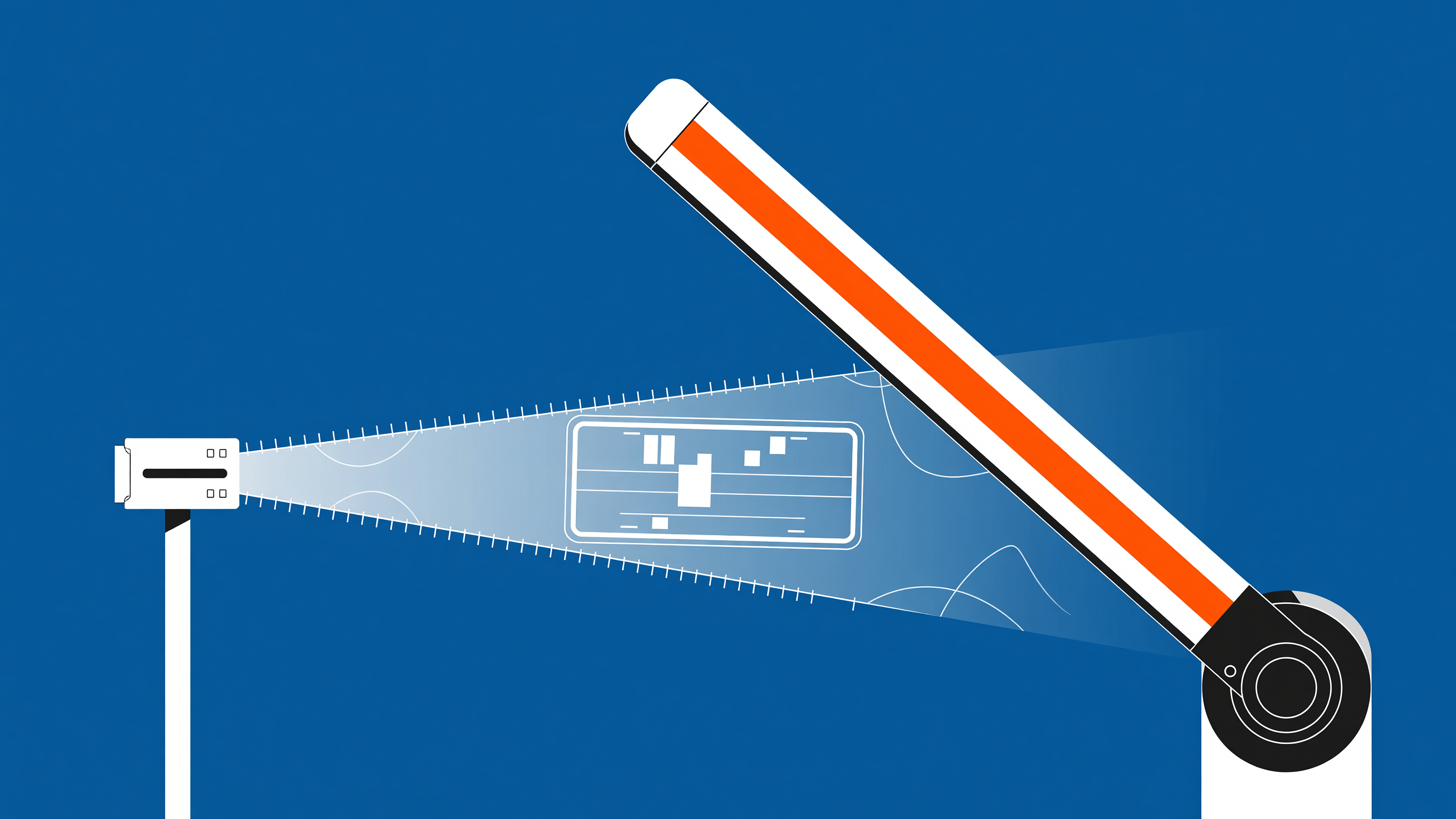
In a gated lot, the gate is the point of control. LPR doesn’t replace it — it feeds it. A camera reads the plate at the entry lane, checks it against your list of known vehicles (monthly parkers, employees, fleet, contract accounts), and if there’s a match, the barrier gate raises. No ticket pulled, no card tapped, no app opened.
The key word is layered. LPR is one credential among several, not a single point of failure:
- Recognized vehicle → gate opens on the plate read.
- Unrecognized vehicle → the lane falls back to the normal flow in the same lane: take a ticket, tap a card, or pay at the station.
Nobody gets stranded at a raised camera because the system “didn’t see a plate.” That matters, because plates are not universal — a missing front plate, a dealer tag, snow, mud, or a bike rack can all defeat a read. A layered design treats LPR as an accelerator for the easy cases, with a dependable manual path for everything else.
Why “frictionless” needs an asterisk
The 2019 buzzword is frictionless — the idea that parking should feel like walking through an open door. It’s a good goal for the customer experience, but the marketing version often implies the gate itself disappears. For most commercial operators, removing the barrier removes the one thing that guarantees a vehicle without a valid credential doesn’t simply drive in and out for free.
So the practical version of frictionless, for a gated operator, is this: the gate stays, but for your known vehicles it opens so quickly and so reliably that the friction is effectively gone. LPR is what closes that gap.
Where it pays off first
LPR tends to deliver the clearest return in a few situations:
- Monthly and employee parking. Your highest-frequency users stop fumbling for a card or fob. Throughput at the busiest entry times improves measurably.
- High-volume entries where a few seconds saved per car adds up to shorter queues during peak arrival.
- Accounts you bill, where the plate becomes a clean, auditable record of who entered and when.
It’s less compelling where nearly every transaction is a one-time visitor — there, the ticket or tap is already the fast path, and LPR is a nice-to-have rather than a difference-maker.
A note on data
Reading plates means storing plate data, and that deserves the same care as any other credential. Decide how long you retain reads, who can see them, and how they tie back to an account. Treat the plate as what it is — a credential — and the privacy questions get a lot more manageable. (We covered credential hygiene in Access Control: Deactivating Old Cards and Fobs.)
The takeaway for 2019
LPR is genuinely one of the more useful tools to reach the gated-parking market in years — as long as you’re clear about what you’re buying. If the goal is enforcement and citations, that’s a different product category. If the goal is to make your gate faster for the vehicles you already trust, while keeping the control that a barrier provides, LPR-within-a-layered-design is exactly the right tool.
For background on how plate reading matured into a practical access technology, see our earlier piece, License Plate Recognition in Parking.
Thinking about adding LPR to a gated lot? Parking BOXX builds it into a layered access approach — recognized vehicles sail through, everyone else uses the normal lane, and the gate always stays in your control. See our parking systems or talk to our team.