
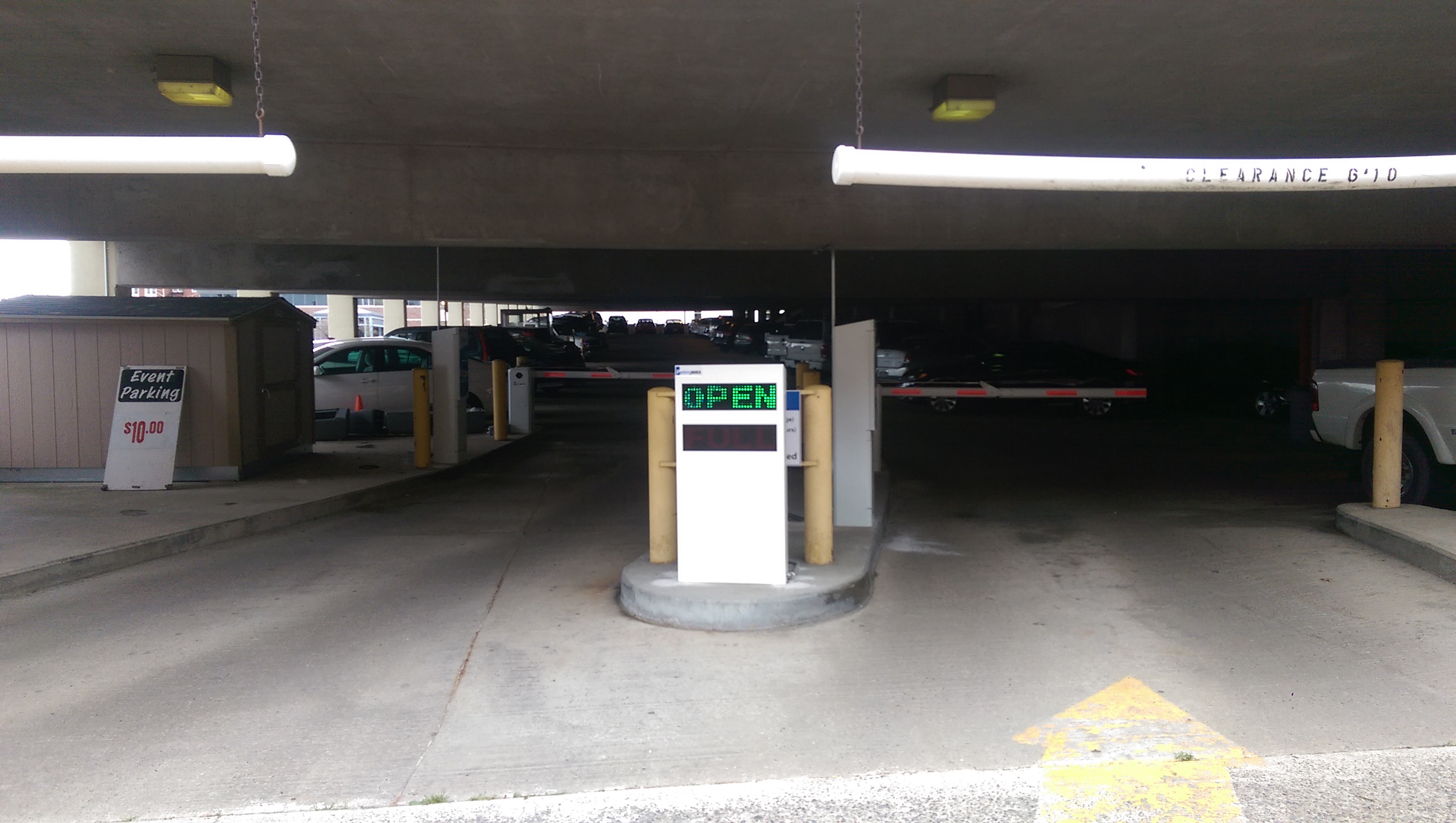
A 400-space downtown garage that runs at 60% occupancy on an average Tuesday still produces 15-minute entry queues on random afternoons. The operator can’t point to an event or a pattern — it just happens. That randomness isn’t a mystery. It’s a well-understood mathematical phenomenon, and there’s a 70-year-old framework built specifically to handle it: M/M/c queueing theory.
If you’ve read our companion piece on D/D/c queueing theory for entry lane planning, you already know the deterministic model — the one built for predictable burst events like stadium discharge or shift change. M/M/c is the other side of the coin: it handles the everyday, random-arrival demand that makes up the majority of operating hours for most parking facilities.
What M/M/c Means in Plain Language
Like D/D/c, the notation comes from Kendall’s classification system for queueing models. Each letter describes an assumption about how the system behaves:
- First M (arrival process): Markovian arrivals. Vehicles arrive randomly according to a Poisson process — the mathematical way of saying “arrivals are independent and unpredictable in any given minute, but follow a known average rate over longer periods.” This is how transient parking demand actually behaves at most facilities.
- Second M (service process): Markovian service times. The time to process each vehicle (ticket issue, credential read, payment) varies randomly around an average. Some drivers are quick, some fumble for their ticket. The variation follows an exponential distribution.
- c (number of servers): The count of lanes, pay stations, or staffed booths operating simultaneously.
The power of M/M/c is that it accounts for the clustering and gaps that happen naturally when arrivals are random. Two vehicles might arrive 3 seconds apart, then nothing for 90 seconds. Over an hour, the average arrival rate is stable — but the minute-to-minute pattern creates temporary queues that a simple average-rate calculation would completely miss.
Why Average Throughput Calculations Fail
The most common capacity planning mistake is dividing total daily vehicles by total operating hours, concluding that your lanes have plenty of throughput, and wondering why queues still form.
Here’s why. If your garage sees 200 vehicles per hour on average and each lane processes 300 vehicles per hour, one lane should be sufficient — right? In a deterministic world, yes. But with random arrivals, vehicles cluster. During any given 5-minute window, you might get 25 arrivals instead of the expected 17. Your single lane falls behind, a queue forms, and it takes several minutes to clear even after the cluster passes.
M/M/c quantifies this precisely. For a single-server system (c=1) with utilization ρ = λ/μ (arrival rate divided by service rate), the expected number of vehicles waiting in queue is:
Lq = ρ² / (1 - ρ)
At 67% utilization (ρ = 0.67), the average queue length is 1.3 vehicles — manageable. At 85% utilization, it jumps to 4.8. At 95%, it’s 18.1. The relationship isn’t linear — it’s exponential as utilization approaches capacity. This is the fundamental lesson of queueing theory that pure throughput calculations miss entirely.
The Practical Inputs You Need
Applying M/M/c to your facility requires three measurements, not estimates:
1. Arrival rate (λ) by time period. Don’t use daily averages. Pull hourly arrival counts from your access control system for at least 30 days. You need the distribution, not just the mean. If your system runs CloudEASE or similar management software, this data is already being logged — you just need to export it by hour of day and day of week.
2. Service rate (μ) per lane or station. Time actual transactions during normal operations — not the equipment spec sheet rate, and not during a burst event. Include the full cycle: vehicle approach, stop, transaction, gate lift, vehicle clear, gate lower. Typical real-world rates:
- Ticket-on-entry lane: 250–400 vehicles/hour (8–15 seconds actual)
- Credential/LPR lane: 500–800 vehicles/hour (4.5–7 seconds actual)
- Pay-on-foot station: 40–80 transactions/hour (45–90 seconds including walking time)
- Exit lane with payment: 60–120 vehicles/hour (30–60 seconds)
3. Number of parallel servers (c). Count your active lanes or stations during each period. If one of three entry lanes is closed during off-peak hours, your c drops from 3 to 2, and the queueing behavior changes significantly.
Utilization Is the Number That Matters
The single most important output of an M/M/c analysis is the utilization factor:
ρ = λ / (c × μ)
This is your arrival rate divided by your total service capacity. It must be less than 1.0 for the system to reach a steady state — if it hits or exceeds 1.0, the queue grows without bound.
But staying below 1.0 isn’t enough. Here’s how queue behavior changes with utilization for a 2-lane entry (c=2):
| Utilization (ρ) | Avg. Queue Length | Avg. Wait Time | Probability of Waiting |
|---|---|---|---|
| 0.50 | 0.17 vehicles | ~2 seconds | 9% |
| 0.70 | 0.65 vehicles | ~7 seconds | 20% |
| 0.85 | 2.2 vehicles | ~24 seconds | 37% |
| 0.95 | 9.3 vehicles | ~100 seconds | 56% |
The practical ceiling for acceptable service in parking operations is typically ρ = 0.80–0.85. Beyond that, queues become visibly problematic and driver satisfaction drops. Plan your lane count to keep peak-hour utilization below 0.85, and you’ll handle the random clustering that average-throughput calculations ignore.
Where M/M/c Applies — and Where It Doesn’t
M/M/c is the right model for:
- Transient downtown garages where arrivals are independent and random throughout the day
- Hospital visitor parking with unpredictable visit timing
- Retail and mixed-use facilities with no dominant event pattern
- Exit lane and pay station planning where departure timing is random
- Staffing decisions for cashiered lanes or customer service booths
M/M/c is the wrong model for:
- Event venue parking with burst arrivals — use D/D/c instead
- Campus or corporate parking with sharp morning peaks — these are closer to deterministic
- Any scenario where arrivals are correlated (e.g., vehicles arriving in platoons from a traffic signal)
Many facilities need both models. A hospital garage has random visitor arrivals all day (M/M/c) plus a deterministic shift-change surge at 7 AM and 3 PM (D/D/c). Model each scenario separately, then size to the binding constraint.
Equipment Decisions Follow From the Math
Once you have your M/M/c analysis, equipment selection stops being a gut decision. The math tells you exactly what happens when you change the service rate variable.
Upgrading two ticket-dispense entry lanes (μ = 300/hr each) to LPR-based credential lanes (μ = 700/hr each) doesn’t just increase throughput. It fundamentally changes the queueing behavior. At 400 arrivals per hour:
- Ticket lanes: ρ = 400/(2 × 300) = 0.67 → average queue of 0.65 vehicles
- LPR lanes: ρ = 400/(2 × 700) = 0.29 → average queue of 0.02 vehicles — effectively zero
That difference matters most during random demand spikes. At ρ = 0.67, a temporary cluster of 10 vehicles arriving in 90 seconds produces a noticeable queue. At ρ = 0.29, the same cluster barely registers. The lower your baseline utilization, the more resilient your system is to the random peaks that frustrate drivers and operators alike.
The same analysis applies to exit capacity. Facilities that have shifted from staffed exit booths to automated pay-on-foot stations combined with barrier gate exits have typically doubled their effective exit service rate — which drops utilization dramatically and eliminates the exit queues that plague older garages during evening rush.
Building This Into Your Planning Process
Capacity planning with M/M/c doesn’t require specialized software. A spreadsheet handles the calculations for c ≤ 10 servers, which covers virtually every parking facility. The steps:
- Export 30 days of hourly arrival/departure counts from your access control system
- Identify your peak non-event hours — the highest-demand periods that recur regularly
- Measure actual service times per lane type during normal operations
- Calculate ρ for your peak hour with current lane count
- Model what-if scenarios: What happens if you add a lane? Upgrade to LPR? Close a lane for maintenance?
The goal isn’t a single number. It’s a table that shows your utilization and expected queue length across your operating hours, so you can make informed decisions about lane count, equipment investment, and staffing schedules.
Parking BOXX works with facility planners and operators across North America on exactly this kind of analysis. Whether you’re designing a new structure or evaluating whether your existing barrier gate configuration can handle growing demand, the conversation starts with the data your system is already collecting. The math just helps you read it.