
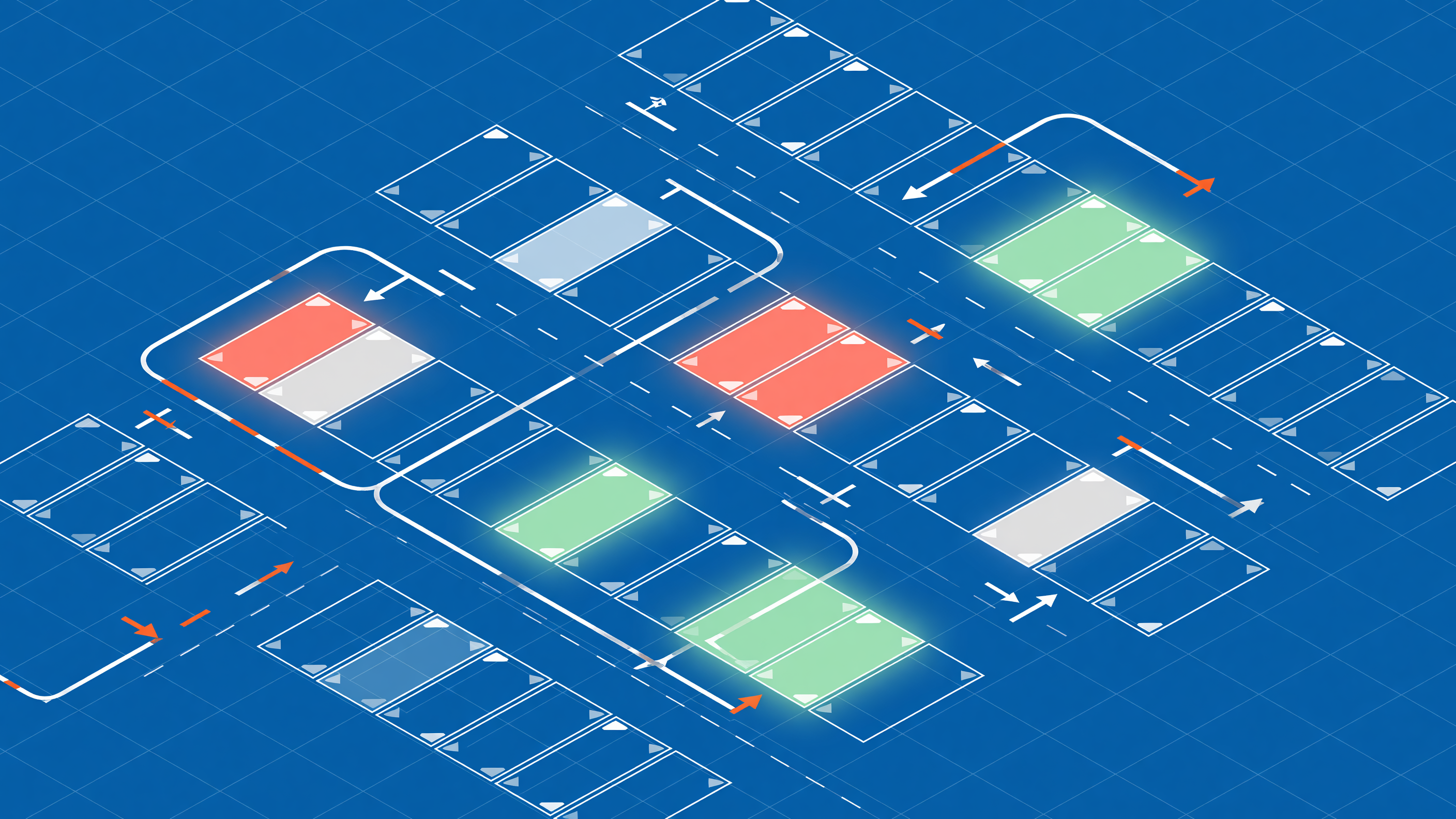
Walk any parking trade show floor in 2019 and you’ll see them: ceiling sensors with red and green lights, big digital signs counting available spaces, apps that promise to guide a driver straight to an open spot. Space-detection and wayfinding technology is genuinely impressive. The harder question — the one worth asking before you sign a purchase order — is whether it pays off for your facility.
The honest answer is: it depends, mostly on size and layout.
What the technology actually does
A guidance system combines two things:
- Detection — sensors (per-space pucks, camera-based counts, or lane counters) that know how many spaces are open and where.
- Communication — signs at decision points and, increasingly, app-based directions that send drivers toward availability.
Done well, the result is less circling, faster parking, fewer frustrated customers, and better use of the spaces you have. Done in the wrong setting, it’s an expensive answer to a problem you didn’t have.
Where it pays off
Guidance tends to earn its cost in facilities where finding a space is genuinely hard:
- Large multi-level garages where a driver can’t see availability from the entrance and might climb three decks before finding a spot.
- Mixed-demand sites — a hospital, airport, or stadium where one zone fills while another sits empty and you want to steer traffic between them.
- Facilities with chronic peak congestion at the entry, where cars stacking up while drivers hunt is causing real queue and throughput problems.
In those settings, cutting the time each car spends searching has a measurable payoff: shorter entry queues, higher effective capacity, and a noticeably better experience.
Where it’s overkill
For a single-level surface lot, or any facility a driver can scan in one glance from the entrance, full per-space guidance is usually hard to justify. The driver already sees what’s open. Spending heavily on sensors and signage to tell them what their eyes already report rarely returns the investment. A simple “Lot Full” indication at the entrance often does the job.
Start with the count you already have
Here’s a practical 2019 tip: if you run a gated facility, you already generate a reliable occupancy count — the entry and exit equipment knows how many vehicles are inside. Before investing in per-space sensors, see how far a simple facility-level count and a “spaces available / full” sign gets you. For many operators that captures most of the benefit (no more cars entering a full deck) at a fraction of the cost of a full puck-and-sign deployment.
You can always layer detailed guidance on top later, where the size and complexity of the facility justify it.
The takeaway
Smart sensors and wayfinding are real, mature technology in 2019 — not science fiction. But “everyone at the show has it” is not a business case. Match the investment to the problem: full guidance where finding a space is genuinely hard, a simple count-and-sign approach where it isn’t, and a clear head about which category your facility falls into.
For more on how connected parking technology is reshaping operations, see Smart Parking Technologies.
Not sure whether your site needs full guidance or just a smarter count? Talk to Parking BOXX — we’ll help you size the solution to the facility, not the trade-show hype.