$1B+ REVENUE FOR OPERATORS
 Parking Made Easy®
1 800 518 1230
Request a Quote
Parking Made Easy®
Installing a barrier gate in Calgary means working with City of Calgary (Development, Business and Building Services and the Calgary Fire Department), under the Alberta Safety Codes Act: fire-access rules, permits, electrical and accessibility requirements all apply*. Parking BOXX is a Canadian manufacturer of barrier gate systems for parking lots and garages in Calgary and the Calgary Metro area, and this page covers what to plan for before you build. * Not legal advice for your situation.
What typically applies to a parking gate project in Calgary, Alberta, with the source for each item.
The Calgary Fire Department's Fire Department Access Standard says plans for emergency access routes and for emergency access gates or bollards go to the Fire Department for review and approval before work begins, whether the file is a land use, subdivision, development permit or building permit application. Emergency access routes restricted from general use are closed with approved break-away bollards or an approved gate, and locks and gates installed under the standard must not be tampered with or removed.
Calgary describes a fire lane, or emergency access lane, as a path reserved for emergency personnel and their equipment, on public roads or private property. The Fire Department may require and designate public or private fire lanes where it considers them necessary for fire apparatus. Designated lanes are marked with signs and must be kept clear of obstructions and vehicles, which is the first thing to check before placing a barrier arm in a drive aisle.
Calgary's complete application requirements list for changes outside a building asks the applicant to label surface materials and dimension aisles and roads, and to show vehicle circulation with direction of travel, signage and fire lanes. It also asks for lockbox, firefighting connection and alarm panel locations with a reference to the Fire Department Access Standard, parking stall dimensions and driveway locations, and fencing height with an elevation for each type.
Source: City of Calgary: Development Permit Requirement List, Changes outside building
Calgary requires an electrical permit for electrical installations in new or renovated buildings, and a certified electrical contractor must apply for it before the work begins. Applicants must hold an Alberta Master Electrician Certificate, have a City of Calgary business licence and complete the City's Qualified Trade application process. Commercial facilities with a full-time journeyman electrician can use an annual permit, and an electrical contractor doing maintenance may apply for one as well.
The Government of Alberta lists CSA C22.1-24, the Canadian Electrical Code (26th Edition), as the electrical code in force under the Safety Codes Act, alongside the Alberta Electrical Utility Code for utility systems. Operator power feeds, control and safety-device wiring, and vehicle-detection circuits at a Calgary gate are installed to that edition. The same government page tracks earlier editions, which matters when a permit was issued under a previous one.
Source: Government of Alberta: Electrical codes and standards
Utility Safety Partners, the Alberta locate service, treats any disturbance of the earth as a ground disturbance regardless of depth, including excavating, trenching, foundation work, and installing or removing fence posts. All underground facilities should be identified and marked before work starts, on public or private land, and a municipality may also require an excavation permit or written permission. Utility members need advance notice, so locates are requested before a crew is scheduled.
Source: Utility Safety Partners: Damage Prevention Process, Homeowners Edition
* Not legal advice for your situation. Requirements change and vary by site and project. Confirm current rules with City of Calgary (Development, Business and Building Services and the Calgary Fire Department), under the Alberta Safety Codes Act before you design or build. This page is a planning guide, not legal or engineering advice.
The City of Calgary's 2024 climate projections note that chinooks are a significant driver of winter freeze-thaw cycles and are not expected to change much with climate change. The historical baseline shows a frost season averaging about 240 days a year, so pavement and soil spend much of the year at or near freezing. Gate foundations, loop slots and pedestal anchors see repeated thaw and refreeze, and chinook melt can refreeze on an arm or operator housing, which favours well-drained footings and sealed, heated or ventilated operator housings.
Calgary experiences dramatic chinook wind events that can swing temperatures by 20°C or more within hours, and prolonged cold snaps well below -30°C, both of which stress parking equipment electronics and gate mechanisms.
Calgary's downtown office parkades, hospital campuses, the university and college districts, LRT park-and-ride lots, airport-area parking and large industrial and logistics yards in the northeast and southeast all rely on controlled vehicle access. Event parking around Stampede Park and entertainment venues adds temporary traffic surges, while heavy-truck yards and compounds usually need long, wide lanes and tight gate sequencing.
Parking BOXX Canadian-manufactured parking systems are built to withstand Alberta's extreme temperature range, and facility managers throughout Calgary benefit from CloudEASE remote management to handle the rapid weather-driven operational changes chinooks bring.
Gate projects in Calgary range from Downtown Core, Beltline, East Village, Kensington and Inglewood to the lots and garages around Calgary International Airport, Scotiabank Saddledome, TELUS Convention Centre.
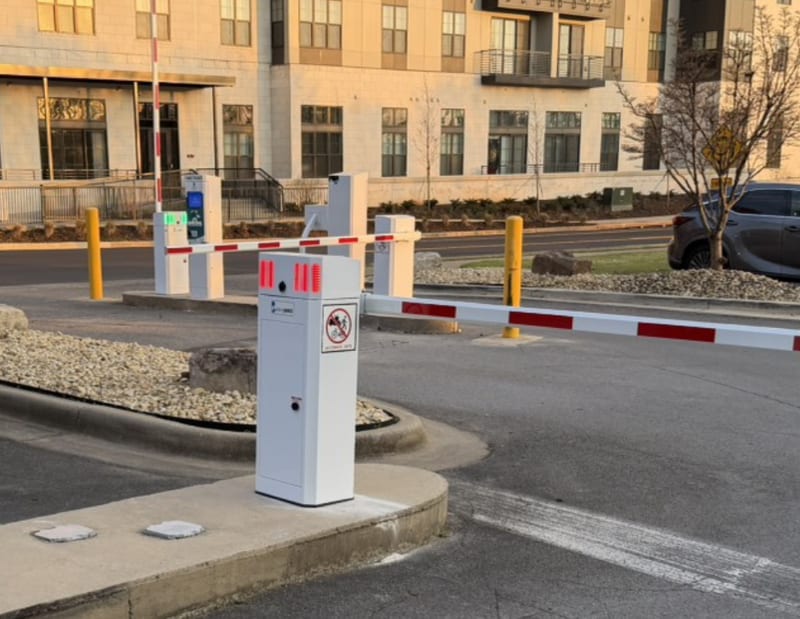
Parking BOXX has 4 installed sites in the Calgary market. These photos show real Parking BOXX barrier gate systems installed and operating in Calgary, Alberta.


The same manufacturer-built gate is installed in every city. Full specifications are on the barrier gates product page.
Typical budgets: a single gate unit runs $2,000 to $6,000, a complete gated entry and exit system starts around $15,000, and full systems with pay stations and LPR run $40,000 to $150,000+. Request an exact quote for your Calgary site.
Calgary's Fire Department Access Standard requires plans for emergency access routes and for emergency access gates or bollards to be submitted for review and approval before work at the land use, subdivision, development permit and building permit stages. A parking gate on or near a fire lane should be raised with the Fire Department in the same way. Requirements vary by project; confirm with the authority having jurisdiction.
A certified electrical contractor applies for the permit before work begins. Applicants must hold an Alberta Master Electrician Certificate, have a City of Calgary business licence and complete the City's Qualified Trade application process. Commercial sites with a full-time journeyman electrician can use an annual permit. The installation follows the Canadian Electrical Code edition declared in force in Alberta. Requirements vary by project; confirm with the authority having jurisdiction.
Calgary's requirement list for changes outside a building asks for dimensioned aisles and roads, vehicle circulation with signage and fire lanes, surface materials, parking stall and driveway details, lockbox and firefighting connection locations, and fence heights with an elevation. Showing the gate, its control point and any fire lane crossing on that same set avoids a second round of review. Requirements vary by project; confirm with the authority having jurisdiction.
Utility Safety Partners defines ground disturbance as any disturbance of the earth regardless of depth, and its examples include foundation work, trenching and installing or removing fence posts. Underground facilities should be identified and marked first, on public or private land, and an excavation permit or written permission may also be needed. Requirements vary by project; confirm with the authority having jurisdiction.
Calgary's chinooks are unique in Canada — no other major city sees such rapid, extreme temperature swings — and they create genuine stress on gate motors and electronic components not designed for it. Parking BOXX equipment is tested and rated for the full Alberta temperature range, from deep-freeze cold snaps to chinook thaw conditions. CloudEASE allows Calgary parking operators to monitor all their equipment remotely, flagging anything that needs attention after a major weather event.
* Not legal advice for your situation. Code and permit answers are general; confirm requirements for your site with City of Calgary (Development, Business and Building Services and the Calgary Fire Department), under the Alberta Safety Codes Act.