
Hospital Parking Systems and Hospital Parking Management
Hospitals face parking challenges that no standard commercial system can solve. Patients arrive stressed and in pain. Visitors circle the lot while their loved ones wait inside. Staff start every shift frustrated by full lots. Emergency vehicles need immediate, unobstructed access at all hours. Hospital parking systems must address all of these demands while remaining accessible, compliant, and easy to manage.
Parking BOXX manufactures healthcare parking systems that handle patient validation, visitor management, staff permitting, and real-time occupancy tracking from a single platform. As a direct manufacturer, Parking BOXX gives hospital procurement teams one vendor, one contract, and one point of accountability for the entire parking operation. Parking Made Easy®.
What Is a Hospital Parking System?
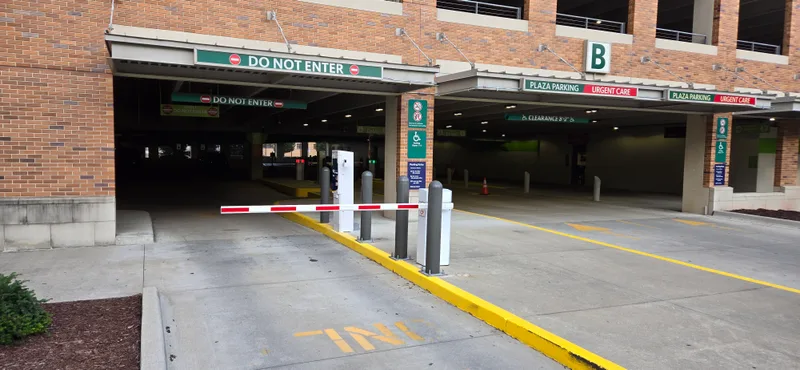
A hospital parking system controls vehicle access, validates patient parking, manages staff permits and tracks occupancy across a healthcare campus. It combines entry and exit gates or LPR cameras, pay stations or ticket machines, and cloud software such as CloudEASE, with patient validation, ADA-compliant equipment and emergency access built in.
Hospital Parking Management Systems: Users and Access Methods
A hospital parking management system treats each user group differently. This table shows how the groups are typically handled and which Parking BOXX equipment and CloudEASE features serve each one.
| User group | Typical stay | Access method | Validation and payment | Equipment and CloudEASE feature |
|---|---|---|---|---|
| Emergency department arrivals | Short, typically 30 to 60 minutes | Dedicated zone next to the ED entrance, kept separate from general parking | Free or low-cost; comped by visit type | Barrier gate with manual release; zone rules in CloudEASE |
| Outpatients | Appointment length, typically two to three hours | Ticket or LPR at entry | Front-desk, appointment-code or kiosk validation; pay at the pay station or with the pay-by-app option | Entry ticket machine, pay station, parking kiosk, validation rules per department |
| Inpatient visitors | Full day or several days | Ticket or LPR at entry | Daily maximums and multi-day passes; pay at the pay station or by app | Time-based rate tiers and daily caps configured in CloudEASE |
| Staff and employees | Shift length, with permits by role | RFID card, fob or license plate at designated gates | Permit billing or payroll deduction; no payment at the gate | Access control credentials, shift-based schedules, permit management |
| Valet drop-off | Visit length; vehicles handed off at the entrance | Staffed handoff at the main entrance | Validated or paid at pickup | Ticketing and validation rules shared with the main system |
| Vendors and contractors | Scheduled windows | Credential or plate with time limits | Billed to the account or exempted | Time-limited credentials in CloudEASE |
Healthcare Parking Challenges
Healthcare parking is not a logistics problem. It is a patient experience problem. A patient arriving for a stressful procedure who spends 15 minutes searching for a space starts the visit in a worse emotional state. Studies consistently link poor parking experiences to lower patient satisfaction scores, and those scores directly affect hospital reimbursement rates under value-based care models.
The challenges are specific to healthcare environments. Large medical campuses have multiple buildings, each with different visitor profiles. Outpatient clinics see rapid turnover. Inpatient wings need long-term visitor parking. Emergency departments need lanes that are never blocked. Rehabilitation centers serve patients with mobility limitations who need accessible spaces close to entrances.
Staff parking adds another layer of complexity. Nurses, physicians, and administrative staff compete for the same spaces as patients during shift changes. Without dedicated zones and controlled access, employee vehicles fill patient-designated areas. The result is a lot that appears full to arriving patients even when staff-only zones sit half empty on the other side of campus.
ADA compliance is non-negotiable in healthcare. Every parking area must provide the correct number and size of accessible spaces based on total lot capacity, with van-accessible spaces, proper access aisles, and connected accessible routes. Parking equipment including ticket dispensers, pay stations, and intercoms must meet reach-range and operability standards. Parking BOXX designs all equipment to ADA specifications, ensuring healthcare facilities meet federal accessibility requirements without retrofitting.
Outpatient facilities carry a higher accessible-space requirement than standard commercial lots. The 2010 ADA Standards call for 10 percent of spaces serving hospital outpatient facilities to be accessible, against about 2 percent for a large commercial lot. Because many patients have mobility limitations without holding a placard, many hospitals plan for 12 to 15 percent. Confirm the count for your campus with your local code official.
Patient and Visitor Parking Management
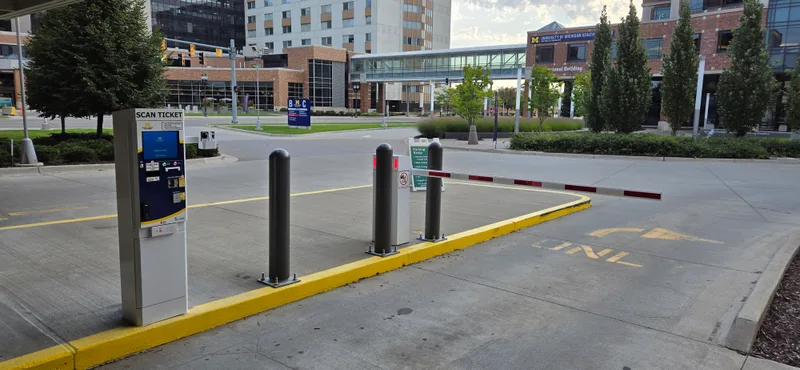
Patients and visitors make up the largest share of hospital parking demand, and they are the most sensitive to friction. A healthcare parking system must get these two groups in and out with minimal confusion, minimal cost disputes, and minimal time spent at equipment.
Patient parking starts with clear wayfinding. Digital signage at lot entrances displaying real-time space counts by zone eliminates circling. Color-coded zones tied to building entrances help patients navigate to the correct area. Ground-level directional markings guide vehicles from the entry lane to the appropriate section.
Visitor parking requires time-based rules. Outpatient visitors typically need two to three hours. Inpatient visitors may need full-day or multi-day passes. Parking BOXX systems allow hospitals to configure time-based pricing tiers: free for the first period, progressive rates after that, and daily maximums that prevent bill shock for families staying through a long procedure.
Real-time occupancy data is critical during peak visiting hours. CloudEASE tracks vehicle counts by zone and pushes that data to entrance signage and the hospital's website or patient portal. When a zone reaches capacity, the system redirects arriving vehicles to overflow areas automatically. This prevents the gridlock that occurs when every visitor tries to park in the closest lot to the main entrance.
Parking validation ties the parking experience directly to the patient visit. Front desk staff validate parking tickets during check-in, or the system validates automatically based on appointment confirmation codes. Either way, patients leave knowing their parking is covered, and the hospital maintains a complete audit trail for accounting.
Staff and Employee Parking
Employee parking is the most predictable segment of hospital parking demand, which makes it the easiest to manage with the right system. The goal is to separate staff from patients, guarantee staff access during shift changes, and eliminate the perception that employees are taking patient spaces.
Dedicated employee lots or zones use access control systems tied to credentials. Staff badge, key fob, or LPR-based recognition opens barrier gates at designated entry points. Only authorized employees enter the zone. This eliminates the problem of visitors parking in staff areas and staff parking in patient areas.
Shift-based allocation solves the overlap problem. Day shift access activates at 5:00 AM and deactivates at 8:00 PM. Night shift credentials work the opposite window. CloudEASE manages these schedules centrally, and administrators can adjust windows during holidays, construction, or special events without reconfiguring hardware.
Monthly permit management through CloudEASE replaces paper hangtags and windshield stickers. Staff register their vehicle license plates in the system. The gate recognizes the plate and opens automatically. If an employee changes vehicles, they update the registration online. No trips to the parking office. No lost permits.
Carpool and sustainability incentive programs are straightforward to implement. The system can designate premium spaces near building entrances for registered carpool vehicles. LPR cameras verify that the vehicle is in the carpool registry before allowing access to the incentive zone.
24/7 Operations, Emergency Access and Valet
Hospital parking never closes, and a facility that treats every user the same fails all of them. The first operational decision is segmentation, with each zone set up for its own users.
- Emergency department access: a dedicated zone next to the ED entrance with short-term free or low-cost parking, typically 30 to 60 minutes. The zone is never converted to general use and is visible from the main entry road without searching for signs.
- Patient and visitor parking: the main zone for transient users, with validation tied to the appointment or registration.
- Employee permit zones: usually on the campus perimeter or the upper levels of a structure, with permit tiers by role. They give predictable base revenue and keep the core visitor zones open for patients.
Valet drop-off is increasingly standard at major medical centers. It serves patients who cannot walk far from a garage and reduces the search traffic that congests main entry lanes. Effective valet programs are staffed for peak admission hours, typically 8 to 11 AM, with clear handoff rules for overnight vehicle storage, and use the same validation rules as the rest of the system.
Real-time occupancy matters for two reasons. Camera-based monitoring shows facility management whether access aisles and fire lanes are clear without a physical patrol, and entry signs that show available spaces by level help staff find a space quickly at shift change on large multi-structure campuses.
For a deeper look at day-to-day operations, read our guide, how to run hospital parking: 24/7 operations, validation and ADA requirements.
Healthcare Parking Validation
Validation is the feature that separates hospital parking from commercial parking. Every healthcare facility needs a way to comp or discount patient parking without creating a system that employees or unauthorized visitors can exploit.
Parking BOXX systems support three primary validation workflows. The first is front desk validation. When a patient checks in, the receptionist scans the parking ticket barcode or enters the ticket number. The system applies the appropriate discount, whether that is full comp, a flat rate, or a time-based reduction. The patient pays the adjusted amount at the pay station on exit.
The second workflow is automated validation tied to appointment confirmation. The patient receives a validation code with their appointment reminder via email or text. At the pay station, they enter the code to unlock the discounted rate. No front desk interaction is required. This reduces lobby congestion and speeds the exit process.
The third is kiosk validation. A self-service parking kiosk in the hospital lobby lets patients scan a QR code from their appointment confirmation or enter a validation number. The kiosk communicates with the parking system in real time to apply the discount. This option works well in high-volume outpatient facilities where front desk staff are already managing heavy patient flow.
Time-based validation rules give hospitals granular control. Pharmacy pickups might receive 30 minutes free. Outpatient visits get two hours. Surgical patients receive full-day validation. Emergency department visits are comped entirely. Parking BOXX parking management systems let administrators configure these rules by department, building, or visit type, and every validation transaction is logged for audit and compliance reporting.
Senior-Friendly Parking Equipment
Seniors are among the largest groups of hospital visitors, and unfamiliar equipment under stress hits them hardest. An unclear pay station with small buttons or cash-only payment creates a barrier with no equivalent in the clinical environment. Parking BOXX has studied how seniors use hospital parking systems, and the findings shape the equipment designed for healthcare settings. See the seniors usability study.
- Large, high-contrast lettering readable from 40 feet
- Oversized, illuminated buttons with clear tactile feedback
- Step-by-step on-screen guidance with pictograms alongside text
- Credit and debit cards as the primary payment method, with the pay-by-app option as an alternative
- Mounting heights that meet accessible reach ranges for every interactive element
- Intercom access for immediate human assistance
CloudEASE for Hospital Parking
CloudEASE is the cloud-based parking management software that ties every component of the hospital parking operation together. Administrators access a real-time dashboard from any browser. No dedicated workstation. No IT department needed to run it.
The occupancy dashboard shows live vehicle counts by lot, zone, and level. Administrators see utilization rates as percentages and can identify underused areas that could absorb overflow from high-demand zones. Historical data reveals patterns: which lots fill first on Monday mornings, which zones empty during evening visiting hours, and where seasonal demand spikes occur.
Revenue reporting breaks down income by lot, time of day, payment method, and validation type. Hospital finance teams can see exactly how much parking revenue comes from visitors versus staff permits versus event parking. Monthly trend reports show whether revenue is growing, stable, or declining.
Patient versus staff versus visitor utilization data helps facility planners make informed decisions about space allocation. If outpatient clinic parking consistently reaches 95 percent capacity while a nearby staff lot sits at 60 percent, the data supports reallocating a section.
Multi-facility support matters for hospital networks. A healthcare system with three campuses can manage all parking operations from a single CloudEASE dashboard. Revenue rolls up to the network level while facility managers retain visibility into their individual campus.
Facility managers overseeing hospital parking programs will find additional operational guidance at Facility Parking Guide, which covers vendor selection, compliance, and maintenance planning.
An important note on healthcare data: CloudEASE does not store patient health information. It tracks vehicles, credentials, and transactions. The system does not connect to electronic health records or store any data classified as protected health information under HIPAA. Appointment validation codes are one-way references that confirm a visit occurred without transmitting clinical details.
Hospital Parking Revenue Without Sacrificing Access
Many administrators worry that charging for parking will upset patients. Patients accept parking fees as reasonable when the experience is smooth, the facility is well maintained and payment is fast. What they do not accept is long exit queues, cash-only payment, confusing instructions or machines they cannot use. A well-designed hospital parking system earns meaningful revenue while keeping patient satisfaction high. The keys are operational reliability, universal payment acceptance (cards, contactless and the pay-by-app option) and clear, accessible equipment.
Built for around-the-clock operation
Hospital parking systems run day and night in all weather and serve visitors with a wide range of physical and cognitive abilities. That calls for reliable equipment that facilities teams can maintain without specialized knowledge, backed by a manufacturer that can respond quickly. Parking BOXX provides unlimited training for hospital facilities management teams, covers common maintenance tasks under warranty and works with local service partners across North America.
Frequently Asked Questions
What is a hospital parking management system?
How do hospital parking systems handle different user types?
How do hospitals validate patient parking?
How much does a healthcare parking system cost?
Can hospital parking systems integrate with appointment scheduling?
What are ADA requirements for hospital parking?
How does smart parking work in hospitals?
Ready to Upgrade Your Hospital Parking?
Parking BOXX manufactures complete hospital parking systems with patient validation, staff access control, visitor management, and CloudEASE cloud reporting. As a direct manufacturer serving all of North America, we handle hardware, software, and installation under one contract. Speak with a parking control systems specialist about your healthcare facility. Parking Made Easy®.