
Parking Entry Lane Sizing and Queuing Analysis Tool
Free interactive tools for parking entry lane sizing and queuing analysis. Enter your peak arrival rate, transaction time, and lane count to calculate lane throughput, maximum queue depth, and average vehicle wait time — before your facility is built or reconfigured. Uses D/D/c and M/M/c queueing models.
Entry Lane Sizing & Queuing Analysis
Use the Capacity Planner tab to calculate how many lanes you need for your peak arrival rate. Use the Queue Analyzer tab to run a full queuing analysis — queue depth, utilization, and average wait time — under D/D/c or M/M/c demand scenarios.
Sizing Parking Entry Lanes Correctly
The most expensive mistake in parking facility design is getting entry lane count wrong. Too few lanes and vehicles stack into the street, frustrating customers and creating safety hazards. Too many lanes and you've over-invested in equipment and real estate that sits idle most of the day. The Parking BOXX capacity planner resolves both problems by grounding lane count decisions in the actual math of traffic flow, not rules of thumb.
What makes this calculation non-trivial is that parking demand doesn't arrive smoothly. Morning commuters cluster in a 30-minute window. Stadium events discharge 2,000 vehicles in 20 minutes. Medical shift changes send 400 vehicles through the gate in under 15 minutes. The capacity planner accounts for your specific arrival pattern — whether you're designing for steady daily traffic or a once-a-week surge event.
What Determines Lane Throughput
Lane throughput — vehicles processed per hour — depends almost entirely on transaction time: the seconds each vehicle occupies the lane. AVI (Automatic Vehicle Identification — a windshield transponder) is the fastest credential method with near-perfect read accuracy, typically under 2 seconds. LPR (license plate recognition) is comparable in speed but with lower read certainty — when a plate is not read, the lane stops until an operator resolves the exception, which pulls effective throughput well below the theoretical maximum. This is why RFID card is kept as a backup credential for LPR lanes. Ticket-dispensing entry (take a ticket, pay on exit) is fast at 4 to 7 seconds and highly reliable. What destroys lane throughput is any form of payment at entry — cash, card, or prepay at the gate routinely takes 30 to 60 seconds or more per vehicle. At 6 seconds per transaction, a lane processes 600 vehicles per hour. At 45 seconds, it handles fewer than 80. Keeping payment out of the entry lane is the single highest-leverage throughput decision.
Planning for Both Daily and Event Demand
Facilities that host periodic events face a dual design challenge: size for events and most of the capacity sits unused on weekdays; size for daily demand and events become a queuing disaster. The queue analyzer handles this with separate models — M/M/c for random everyday demand and D/D/c for deterministic burst events. Use both to find the lane count that keeps queues manageable under both scenarios, or to evaluate whether adding one lane for events versus adding a second exit lane makes more operational sense.
The Queueing Models Behind the Tool
The queue analyzer uses two mathematical models from queueing theory, each suited to a different operating scenario. Understanding which model applies to your facility helps you interpret the results correctly and plan for the right worst case.
D/D/c — For Burst Events and Predictable Surges
The D/D/c model is built for facilities where arrivals cluster in a predictable burst: stadium or arena discharge, hospital shift change, campus event exit, shift-end at a large employer. In Kendall's notation, the two D's stand for deterministic — arrivals arrive at a known rate and each transaction takes a known fixed time. The c is the number of lanes.
In a D/D/c scenario, a queue forms the exact moment your arrival rate exceeds your service rate, and it grows linearly until the burst ends. There is no statistical relief from random spacing — if 120 vehicles per hour are arriving and your lane can process 100 per hour, that deficit accumulates second by second. The D/D/c queue analyzer calculates the maximum queue length at peak and the total clearance time after the burst ends.
M/M/c — For Random Everyday Demand
The M/M/c model covers the random transient demand that fills most operating hours at most parking facilities. The M's stand for Markovian — arrivals follow a Poisson process (random, unpredictable minute-to-minute but with a stable average rate) and service times are exponentially distributed. This is the statistical behavior of transient parking demand at garages, surface lots, and retail parking on typical operating days.
The M/M/c model reveals an important counterintuitive result: queues can form at random even when average lane utilization is well below 100 percent. A single lane at 80 percent utilization will produce a 4-vehicle average queue due to the variability of random arrivals. Adding a second lane drops that queue to near zero — not because average demand changed, but because two lanes handle arrival bursts far better than one highly-loaded lane. This is why facilities with "plenty of capacity on average" still produce daily queuing complaints.
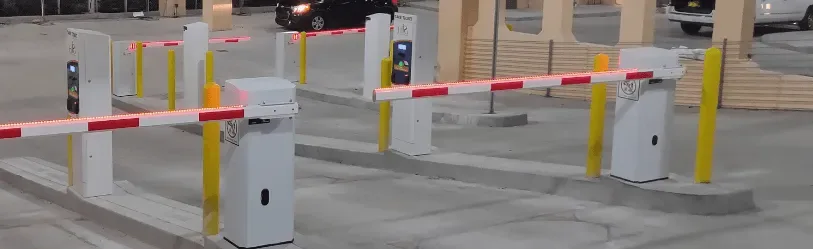
Understand when D/D/c applies, how to calculate worst-case queue length for burst events, and when adding a lane matters versus reducing transaction time.
Read the article →
Learn how random arrival patterns produce unexpected queues, what utilization thresholds trigger sustained queuing, and how to use M/M/c to validate your lane count.
Read the article →Reducing Entry Wait Times in Practice
Queue analysis tells you how long vehicles wait given your current configuration. The next step is identifying the highest-leverage intervention — adding lanes, reducing transaction time, or changing how demand reaches the entry point.
Reduce Transaction Time First
The highest-impact change is removing payment from the entry lane entirely. Prepay and any pay-at-entry transaction — cash, card, or mobile — are the primary queue creators. Moving payment to pay-on-foot kiosks or pay-on-exit keeps the entry lane doing what it does fastest: dispensing a ticket in 3 to 5 seconds and lifting the gate.
For monthly and credentialed parkers, LPR is the primary access method, with RFID card kept as backup for cases where a plate read fails. Both process a vehicle in 1 to 3 seconds — close to AVI transponder speed. AVI remains the gold standard for read accuracy at near-perfect rates; LPR trades some of that certainty for eliminating the need to issue and manage transponders. Dedicated credential lanes for monthly parkers keep their fast transactions separate from transient ticket lanes, preventing either group from slowing the other.
Add Lanes When Utilization Exceeds 80 Percent
In the M/M/c model, the relationship between utilization and queue length is non-linear. At 50 percent utilization, queues are negligible. At 70 percent, they're manageable. At 85 percent, average queue length starts growing rapidly. At 95 percent, queues become practically unbounded. If your existing lanes are regularly operating above 80 percent utilization during peak periods, adding a lane will reduce wait times far more than any transaction-time improvement can.
The capacity planner calculates the utilization rate of your current lane configuration. Use that number to determine whether you're in transaction-time territory or lane-count territory — the right answer depends on where you sit on the utilization curve.
Managing Event Facility Demand
For stadiums, arenas, and event venues, the hard reality is that discharge arrivals cannot be spread over time — when a game or concert ends, vehicles arrive in a concentrated burst and no operational strategy changes that. The workable solutions are adding physical capacity and speeding up transactions.
Adding lanes is the primary answer. The queue analyzer lets you model exactly how many lanes you need to clear the burst within an acceptable window. Human attendants also make a material difference: staff with handheld devices can process credentials and payment away from the gate while vehicles queue, and an attendant stationed at a pay kiosk can guide unfamiliar users through the transaction in a fraction of the time it would take unassisted — turning a 45-second transaction into a 15-second one.
On the entry side, incentivizing early arrival (dinner before the show, early-bird pricing) can reduce the pre-event entry surge. The constraint is that your monthly and commuter parkers need those same spaces during the hours before the event, which limits how aggressively you can push early-bird offers without creating a conflict. The queue analyzer helps you model what a reduced pre-event arrival rate actually buys you in lane count versus what it costs operationally.
Frequently Asked Questions
The number of entry lanes depends on your peak arrival rate and transaction mix. Ticket dispensing, LPR, AVI, and RFID credentials all process a vehicle in 1 to 5 seconds — a single lane in this range handles 700 or more vehicles per hour. Prepay and pay-at-entry (cash or card at the gate) collapse that throughput to under 100 vehicles per hour. A facility expecting 300 vehicles in a 90-minute peak with fast transaction types needs at least two lanes — more if payment at entry is part of the mix. Use the capacity planner above to calculate the exact count for your arrival rate and transaction types.
A parking queue analyzer is a tool that models how vehicles accumulate in entry lines based on arrival rates and lane throughput. It calculates maximum queue length, average wait time, and the utilization threshold at which queues become unacceptable. The Parking BOXX queue analyzer uses both D/D/c (deterministic burst events) and M/M/c (random everyday demand) models so operators and designers can evaluate all operating scenarios in one place.
Entry queues form whenever vehicles arrive faster than lanes can process them. The most common cause is payment at entry — prepay, cash, or card at the gate takes 30 to 60 seconds per vehicle and collapses lane throughput. Ticket dispensing, LPR, AVI, and RFID are all fast; the problem is mixing slow pay-at-entry transactions into the same lane as fast transactions. Too few lanes for peak demand and burst events are the other main causes. A queue analyzer identifies which factor limits throughput so operators can address the right problem.
D/D/c queueing theory models facilities where arrivals come in a predictable burst — stadium discharge, concert exit, shift change. The two D's stand for deterministic arrivals and deterministic service time; c is the number of lanes. In a D/D/c scenario, a queue forms the moment arrival rate exceeds lane capacity and grows linearly until the burst ends. The model calculates exactly how long the queue gets and how long the average vehicle waits. Our blog article on D/D/c entry lane sizing explains the method in detail.
M/M/c queueing theory models facilities with random, everyday demand — the transient arrivals that characterize most garages and lots during normal operating hours. The M's stand for Markovian (Poisson-distributed) arrivals and exponentially distributed service times. M/M/c explains why queues form randomly even when lanes appear to have enough capacity on average. Once a single lane exceeds roughly 80 percent utilization, queue length grows sharply. See our article on M/M/c capacity planning for the full methodology.
The highest-impact change is keeping payment out of the entry lane. Prepay and pay-at-entry (cash or card at the gate) are the primary queue creators — shift payment to pay-on-foot kiosks or pay-on-exit and all entry transactions drop to 1 to 5 seconds. For credentialed parkers, LPR is the primary access method with RFID card as backup for missed reads; AVI transponders deliver similar speed with higher read accuracy. Once transaction mix is clean, if utilization still exceeds 80 percent at peak, adding a lane will have the greatest remaining impact. For event facilities, pre-booking and staggered entry windows reduce peak arrival rates at the source.
Yes. Parking BOXX provides complimentary facility layout review as part of the system quoting process. We analyze your expected peak arrival rate, site geometry, access control requirements, and budget to recommend the right lane count, equipment type, and configuration — including barrier gates, LPR cameras, and pay-on-entry or pay-on-foot options. Request a quote to start the process.
Ready to size your entry lanes for real demand?
Request a quote to receive a complimentary entry lane analysis and system recommendation from Parking BOXX — Parking Made Easy®.